Natsar Cybersecurity Insights
- Mar 6, 2025
VPNs and Beyond - How to Protect Remote Access Without Compromising Security
- Josh Moulin
- Cybersecurity, Digital Privacy
- 0 comments
Subscribe To Get Notified of New Content!
Your information stays with Natsar—we never sell it or share it.
Intended Audience: Cybersecurity professionals, IT leaders, business executives, and anyone responsible for securing remote access for their organization
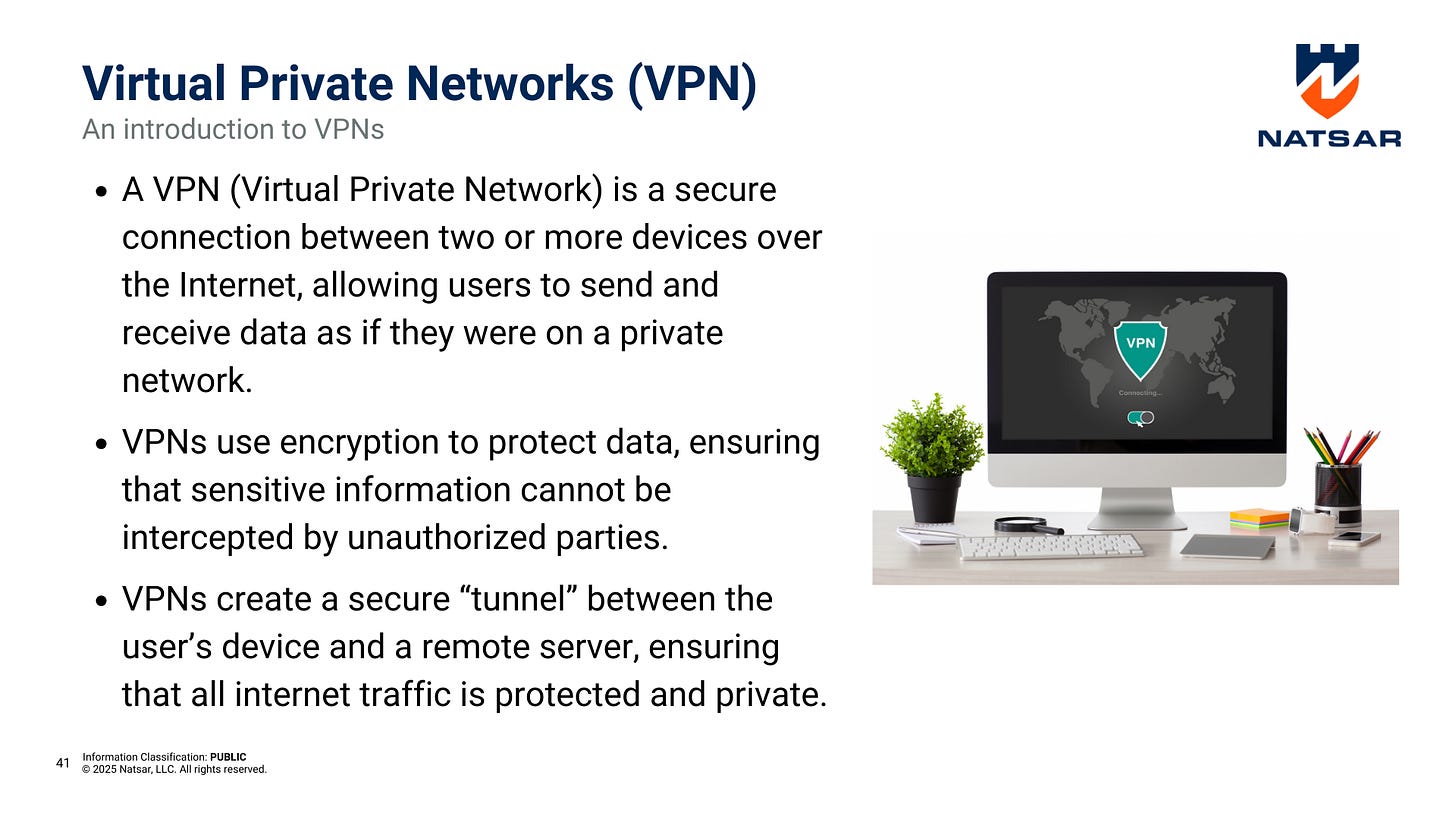
Slide from Natsar’s Course Introduction to Defense in Depth and Secure Network Design.
The Remote Work Reality and the VPN Security Challenge
Remote access has become an integral part of modern business operations, enabling employees, contractors, and third parties to work from anywhere. Virtual Private Networks (VPNs) have long been the go-to solution for securing remote access by creating encrypted tunnels between users and enterprise networks. However, as cyber threats evolve and attack surfaces expand, relying solely on VPNs introduces significant security risks.
I spoke with SC Media about the continued use of VPNs post-COVID and why businesses are now exploring better alternatives. While VPNs remain dominant, organizations are beginning to recognize their limitations and seek more secure solutions. You can read the full interview here: VPNs Still Dominate Post-COVID, But Businesses Are Sniffing for Alternatives.
While VPNs are still widely used, organizations must understand their limitations and explore emerging alternatives to secure remote access effectively. In this post, we’ll examine how VPNs work, their vulnerabilities, and better solutions like Zero Trust Network Access (ZTNA) that provide stronger security in today’s threat landscape.
The Problem with Traditional VPNs
VPNs encrypt network traffic and provide a secure tunnel between remote users and enterprise systems, but they were designed for a different era—when remote access was the exception, not the norm. Today, with widespread remote work and cloud-based applications, VPNs introduce several security challenges:
Implicit Trust Model: VPNs operate under an “all or nothing” approach—once a user gains access, they often have broad access to internal systems, even if they only need one application.
Lateral Movement Risk: If an attacker compromises VPN credentials, they can move laterally across the network, accessing sensitive systems and data.
Performance Issues: VPNs can become a bottleneck, degrading network performance as more users connect.
Misconfigurations and Split Tunneling Risks: If improperly configured, VPNs can expose corporate data to untrusted networks or allow attackers to bypass security controls.
Credential Theft and Phishing Risks: Attackers frequently target VPN credentials through phishing campaigns, and many organizations lack multi-factor authentication (MFA) protections.
Enhancing VPN Security
If your organization still relies on VPNs, consider these best practices to improve their security:
Enforce Multi-Factor Authentication (MFA): Never rely on passwords alone; MFA significantly reduces the risk of credential theft.
Limit Access with Least Privilege: Ensure VPN users can only access the systems they need, minimizing the impact of potential breaches.
Monitor and Log VPN Activity: Use Security Information and Event Management (SIEM) systems to analyze remote access logs and detect anomalies.
Segment Network Access: Prevent lateral movement by restricting VPN users to isolated network segments rather than giving them broad access.
Regularly Patch and Update VPN Software: Ensure your VPN appliances and software are updated to mitigate known vulnerabilities.
Only Allow Company Assets to Connect: Install trusted certificates on company-managed devices to ensure that both the user and the device are authorized to connect to the corporate network. This prevents unauthorized personal devices from gaining VPN access, reducing the risk of unmanaged endpoints introducing security threats.
Moving Beyond VPNs: The Case for Zero Trust Network Access (ZTNA)
Many organizations are shifting toward Zero Trust Network Access (ZTNA) as a modern alternative to VPNs. Unlike VPNs, which operate on implicit trust once a user connects, ZTNA operates on a zero-trust mindset, trust is never assumed and must always be verified.
ZTNA is a Mindset, Not Just a Technology
ZTNA is not a single tool or software solution, it is a security philosophy that fundamentally changes how access is granted. Traditional VPNs connect users to a network, while ZTNA connects users to applications based on continuous verification of identity, device health, and contextual access controls.
Key Principles of ZTNA
Least Privilege Access: Users only access the applications they need, reducing the attack surface.
No Broad Network Access: Eliminates lateral movement risks by granting access at the application level, not the network level.
Continuous Verification: Security policies constantly evaluate user identity, device health, and risk posture before granting access.
Seamless Integration with Cloud and On-Prem Systems: Unlike VPNs, which are often tied to on-prem infrastructure, ZTNA is designed to secure cloud-first environments.
ZTNA vs. VPN Which One is Right for Your Organization?
VPN Strengths:
✔ Works well for organizations with traditional, on-prem applications
✔ Provides secure remote access for trusted users
✔ Familiar technology with widespread adoption
ZTNA Strengths:
✔ More secure than VPNs by eliminating broad network access
✔ Ideal for cloud-based and hybrid environments
✔ Reduces risk by continuously verifying access permissions
A hybrid approach, using VPNs for legacy applications while adopting ZTNA for modern workloads can be an effective transition strategy.
Bottom Line
VPNs have long been the standard for remote access security, but their limitations make them increasingly vulnerable in today’s evolving threat landscape. Organizations must strengthen VPN security through MFA, least privilege access, network segmentation, and endpoint verification, or transition to a Zero Trust Network Access (ZTNA) model that eliminates implicit trust and provides application-specific access controls. Moving beyond VPNs is essential for reducing risk and securing remote workforces.
Learn More About Defense in Depth and Earn a Continuing Education Certificate
For a deeper dive into implementing Defense in Depth strategies, watch our no-cost training video, Introduction to Defense in Depth, available on YouTube or through Natsar’s website. Completing the training on Natsar’s website allows you to earn a certification for Continuing Professional Education (CPE) credits—ideal for cybersecurity professionals looking to enhance their expertise.
How Natsar Can Help
Natsar provides expert-led training and consulting services to help organizations implement Defense in Depth strategies effectively. Whether you need assistance with network security, zero trust, endpoint protection, or compliance, we offer customized solutions to strengthen your security posture.
Visit Natsar’s website to explore our training, cybersecurity assessments, and risk management solutions.